Seollal
O fenômeno Jungkook: O sucesso do BTS e a criação de um superstar mundialSeollal is the Korean lunar New Year, but in Jungkook’s story it becomes more than a calendar marker. It names the home he wants to return to after another late rehearsal, the family waiting beyond the studio, and the ordinary adolescence his work has displaced. Its importance lies in the contrast between a culturally familiar holiday of reunion and the precarious, disciplined life of a trainee whose future is still uncertain.
A Holiday Beyond the Practice Room
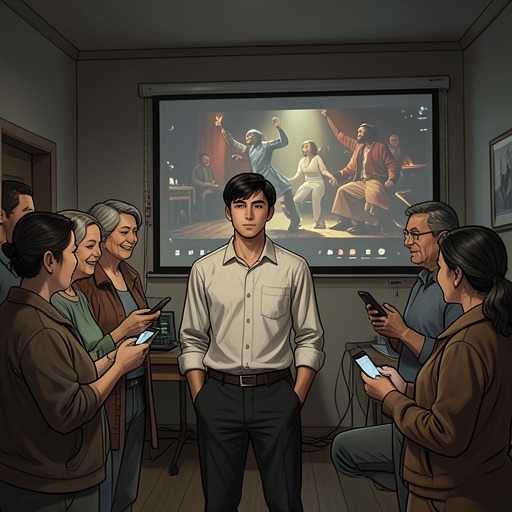
Seollal appears during the period when Jungkook is still a young trainee in a small Bangtan Room studio, working amid a Maschine MIDI controller and an ASR 10 synthesizer. After another rehearsal that has run late, he arrives still wearing his winter graduation coat, its hood framing his unmade-up face. The setting is not celebratory: it is a modest creative workspace where the boys film vlogs, make music, and continue training after the formal day has ended.
The timing sharpens the scene’s emotional pressure. Jungkook says that Seollal is approaching and that he wants to go home soon because he wants to see his mother and father, who will all be waiting for him. The holiday therefore functions as a social and familial counterweight to the studio’s repetitive demands. While training keeps him inside an uncertain professional future, Seollal recalls a household and a shared ritual that remain tangible even when success is not guaranteed.
Vulnerability and Professional Discipline
Jungkook records the reflection after his graduation, expecting that the milestone would make him happy but admitting that he does not feel well after graduating. His pauses, lowered head, and repeated nods make the uncertainty physical without turning it into a complaint. He is one of many young men competing for a place in an industry crowded with aspiring groups and performers, and the narrative emphasizes that the sacrifices of training have not yet produced any assurance of debut or recognition.
His wish to see his parents exposes what the professional routine costs him: not merely leisure, but time with the people who would ordinarily accompany a major transition in his life. Yet the scene ends not with withdrawal but with continued work. Jungkook smiles toward the camera and returns to the discipline he can control. Seollal thus marks the tension between private need and public professionalism: he remains a homesick adolescent while learning to behave like a dependable future performer.
Family Time and the Idol System
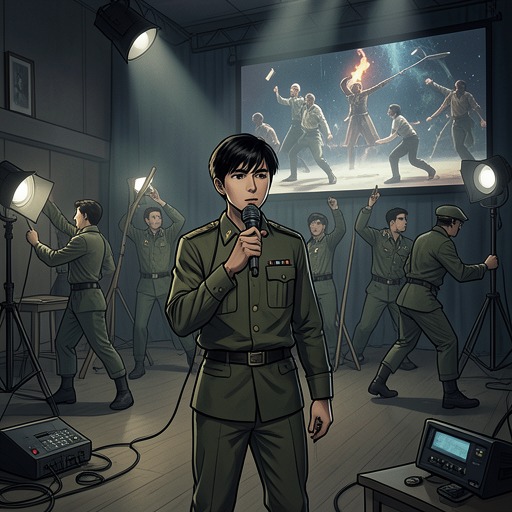
The holiday’s meaning becomes clearer against the wider system surrounding Jungkook. The idol industry demands long rehearsals, tightly managed appearances, controlled interactions, and bodies shaped through exercise, restricted diets, cosmetics, and constant presentation. Even later, after his public image has become globally recognizable, his work remains organized around preparation and performance: in 2017 he rehearses with BTS in Los Angeles, quietly sings to himself while sitting in makeup, and then takes the lead during repeated performances of "DNA."
That contrast gives Seollal a distinctive narrative role. The holiday points toward an uncurated self—someone who wants to be with his parents—while the idol system turns his face, body, voice, and movement into public material. His later visibility includes tattoos, intense beauty expectations, spontaneous Weverse broadcasts, and the carefully staged presentation of Golden. Seollal belongs to the earlier, more vulnerable side of that trajectory, before the professional persona has fully eclipsed the boy who wants to go home.
A Threshold in a Longer Passage
Seollal also operates as a threshold between childhood and adulthood. Jungkook has just graduated, but the scene refuses a simple coming-of-age triumph. He is old enough to recognize what he has sacrificed, yet young enough to measure the night by the hour and imagine his parents waiting at home. The holiday makes the transition cyclical and familial, while his training makes it competitive and linear: he must keep moving forward even without knowing whether the effort will succeed.
Later passages show other abrupt thresholds in his life, including the end of his first solo campaign and the preparation for military enlistment. Before enlistment, he completes a triumphant showcase for 2,800 fans at Jangchung Arena, then has his head shaved as his eight-month solo period comes to an end. The contrast is revealing. Seollal represents the pull of home during an uncertain beginning; the later haircut represents a forced departure from idol life after international success. In both moments, personal time is measured against institutional demands.
Narrative and Thematic Significance
The scene gives Seollal an emotional function without reducing it to background custom. It is the occasion that makes Jungkook’s lost time visible. His desire to see his parents does not cancel his ambition, and his decision to continue practicing does not erase his vulnerability. Instead, the holiday holds both facts together: the future star is already extraordinarily determined, but he is still a son longing for the people who will be waiting for him.
By placing this longing inside a late-night studio, the narrative turns Seollal into an image of divided belonging. Jungkook’s career eventually carries him to international stages, Times Square, London, and a solo showcase in Korea, yet the early holiday memory preserves the private scale from which that public ascent began. The most consequential feature of Seollal in the story is therefore its reminder that professional transformation is built from ordinary separations—leaving home, missing family, and continuing to work while the desired future remains unconfirmed.